
One of the issues assigned to the ABGA Breed Improvement Committee was the aging of goats and the need for more objective information about whether an animal's reported age is consistent with its weight and stage of development. Following extensive discussion by the committee and Board of Directors, ABGA determined that the best starting point was to collect reliable, breed-specific growth data.
That decision led ABGA to weigh every goat in the junior (0-12 month) age division exhibited at the 2025-2026 Regional Show Series and also the 2026 National Show. The below information is strictly from 2026 Nationals data.
Using each animal's show weight, reported date of birth and an estimated birth weight of eight pounds, ABGA calculated an estimated weight per day of age as follows: (Show weight - 8 pounds) / days of age
While weights have previously been recorded at nationals, much of that data is missing important pieces of information or complete sections of data. The 2026 data gives ABGA a large set of standardized growth information collected from goats across the United States.
Fullblood and Percentage Comparison
When the results were separated by registration type, Fullblood animals consistently performed higher, as expected, when measured by average weight per day of age. That pattern held in every age category for both sexes. Across all ages, Fullblood does averaged 0.498 pounds per day, 0.041 higher than the 0.457 average for Percentage does. The difference was also consistent among bucks. Overall, Fullblood bucks averaged 0.633 pound per day, 0.074 higher than the 0.559 average for Percentage bucks. Although the size of the difference varied by age, the direction never changed across the eight age-by-sex comparisons.

For the remaining graphs, Fullblood and Percentage animals were combined within each age-and-sex category. The comparisons highlighted here include 210 bucks and 413 does between 0-12 months of age.
The clearest pattern was that the calculated rate of gain declined as animals became older. This occurred in both bucks and does.
Age | Bucks average | Does average |
0-3 months | 0.667 lb/day | 0.577 lb/day |
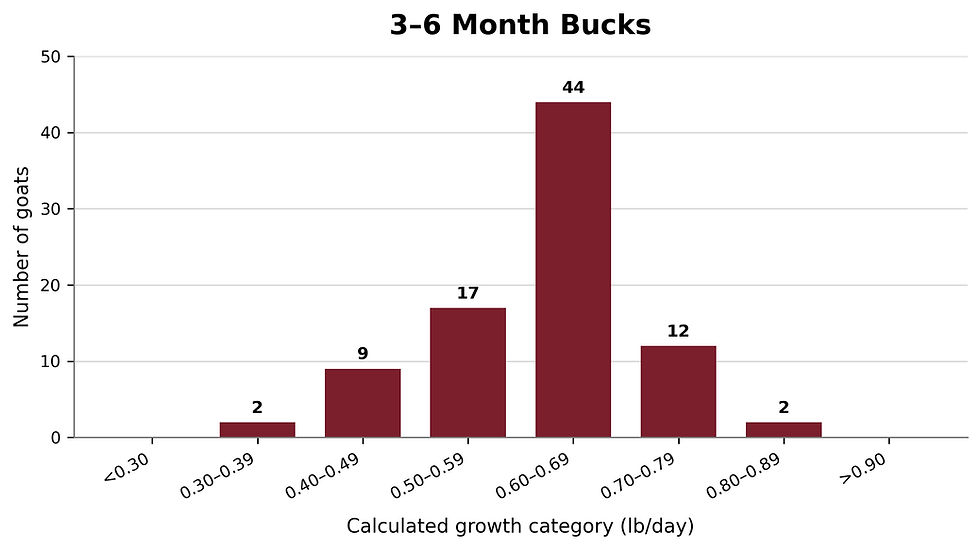
3-6 months | 0.620 lb/day | 0.487 lb/day |
6-9 months | 0.555 lb/day | 0.438 lb/day |
9-12 months | 0.504 lb/day | 0.399 lb/day |
The median values followed nearly the same pattern, indicating that the averages were not driven solely by a few unusually high- or low-gaining animals.
Buck Data
Among the 0-3-month bucks, most animals were between 0.50 and 0.79 pound per day. The 0.50-0.59 and 0.60-0.69 categories each contained 18 bucks, while another 17 were in the 0.70-0.79 category. The distribution shifted lower with age. The largest group of 3-6-month bucks was between 0.60 and 0.69, the largest group of 6-9-month bucks was between 0.50 and 0.59, and the largest group of 9-12-month bucks was between 0.40 and 0.49 pound per day.


Doe Data
The same progression was evident among the does, although their calculated rates were lower than those of the bucks in every age category. The largest group of 0-3-month does was between 0.60 and 0.69 pound per day. Most 3-6-month does were between 0.40 and 0.59, while the majority of both 6-9-month and 9-12-month does were between 0.30 and 0.49 pound per day.


Understanding What the Calculation Measures
Although these figures have been referred to as average daily gain, it is important to understand the limitations of that terminology.
Traditional average daily gain is calculated by weighing an animal at the beginning and end of a defined period. Because ABGA did not have an actual birth weight or an earlier scale weight for each animal, this calculation cannot measure the animal's gain during a specific recent period.
For practical purposes, the data functions more like an adjusted weight-per-day-of-age measurement. Subtracting an estimated eight-pound birth weight improves the calculation, but it remains an estimate of average growth over the animal's entire life rather than a direct measurement of gain during its most recent 30, 60 or 90 days.
That distinction becomes especially important as animals get older. Young animals generally grow rapidly, but their rate of gain slows as they mature. An older animal's cumulative weight per day of age still includes the faster growth it experienced early in life. If that cumulative average decreases as the animal ages, its actual daily gain during the later portion of its life is likely lower than the lifetime figure shown in these charts.
For example, the average calculated figure declined from 0.667 pound per day for 0-3-month bucks to 0.504 pound per day for 9-12-month bucks. That does not mean a typical older buck is currently gaining half a pound every day. Because the calculation includes the buck's faster early growth, its actual rate of gain during the later months would generally be lower than its lifetime average.
The same principle applies to does. Their average declined from 0.577 pound per day in the 0-3-month group to 0.399 pound per day in the 9-12-month group. This downward pattern is biologically reasonable and reinforces why animals must be compared with others of the same sex and a similar age.
What the Weigh-Backs Showed
At the beginning of the National Show, show staff weighed every animal one time on the official show scales, and that measurement became the animal's official weight. The top two animals in each class were then weighed back on the same scales. In total, 117 animals were weighed back from one to five days after their original official weight. Every animal remained within a five-pound weigh-back range, so no animal would have been disqualified—even among those shown as many as five days after the initial weigh-in. Seven animals differed by more than three pounds: two lost four to five pounds and five gained four pounds. ABGA will use this information when determining whether initial weigh-ins, weigh-backs or a combination of the two should be used in the future. Just as importantly, it gives members a strong starting point for understanding the amount of weight movement most animals can be expected to show during Nationals.

How ABGA Will Use the Information
This first year of data gives ABGA an important foundation, but it should not be treated as a final growth standard. National Show entries represent a selected group of goats managed under many different environments, feeding programs and production systems. The calculations also depend on accurate dates of birth and apply the same estimated birth weight to every animal.
Going forward, ABGA can continue collecting this information to develop normal ranges for each age and sex category. Multiple years of data will help the association determine which patterns are consistent and which results may be unique to a particular year, management environment or group of animals.
As the database grows, this information can support breed improvement by helping breeders better understand expected growth at different stages of development. It can also help ABGA identify records that fall well outside the normal range for an animal's age and sex. An unusual result would not automatically prove that information is incorrect, but it could provide an objective reason to review the animal's records or gather additional information.
The long-term goal is not to establish one rate of gain that every Boer goat must achieve. The goal is to define reasonable, data-supported parameters that recognize the biological differences between bucks and does and the natural decline in growth rate as goats mature.
By weighing animals, collecting accurate dates of birth and continuing this analysis over multiple years, ABGA can replace assumptions with breed-specific information. That information can improve selection decisions, strengthen confidence in reported ages and give breeders another practical tool for evaluating growth and improving the Boer goat.


